For decades, classical computers have been following the path laid out by Moore’s Law – doubling their processing power every 18-24 months by packing more and more transistors onto silicon chips. However, we are rapidly approaching the physical limits of how small and fast these conventional computers based on classical physics can become. To sustain the incredible rate of progress in computing that has enabled everything from smartphones to machine learning, we need to explore new paradigms that can take us beyond the limitations of classical computing. This is where quantum computing comes in – an approach that harnesses the mind-bending principles of quantum mechanics to process information in fundamentally new ways.
What is Quantum Computing?
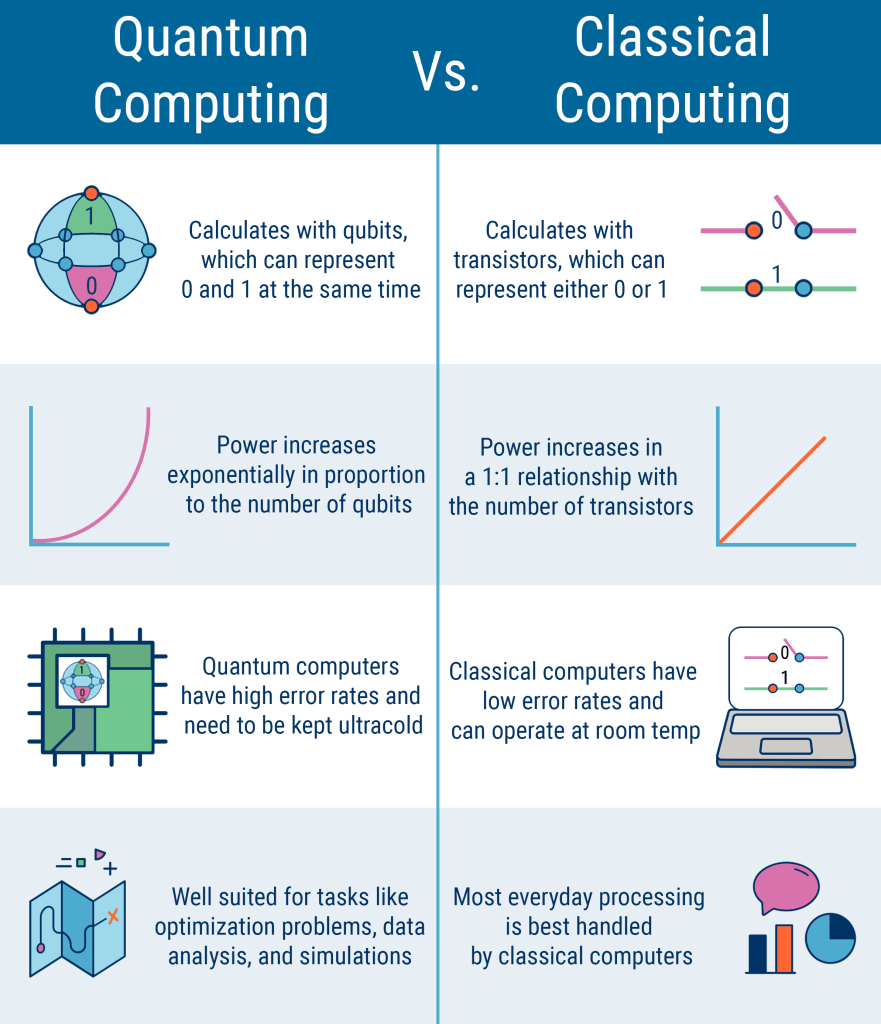
At its core, quantum computing is a radical departure from classical computers in how it processes and stores information. Classical computers encode data into binary digits or “bits” represented by either a 0 or a 1 state. In contrast, quantum computers use quantum bits or “qubits” that can exist as a 0, 1, or crucially – both states simultaneously through a quantum superposition.
This strange characteristic of quantum physics allows a single qubit to do more than just encode a 1 or 0, but also a complex mathematical relationship representing varying probabilities of 1 and 0 states in a smeared quantum state. It’s this ability to generate and manipulate these quantum states and qubits that unlocks quantum parallelism – the key advantage of quantum computers in being able to solve certain problems exponentially faster than classical machines.
How Quantum Computers Work
The Principles of Quantum Computing
So how does a quantum computer actually operate and leverage these quantum mechanics quirks? At the core are two key principles: quantum superposition and quantum entanglement.
Superposition is the ability for particles at the quantum level to exist in multiple possible states concurrently. In classical physics, particles have a definite state – like the binary 0 or 1. But in quantum mechanics, particles can exist as a combination or superposition of multiple states at the same time, codified in their waveform.
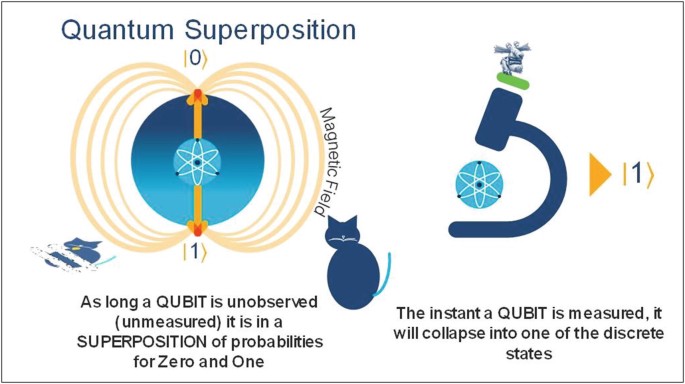
This property allows qubits in a quantum computer to represent multiple possible combinations of 1 and 0 concurrently in a blended “superposition” state that encompasses all those states simultaneously. The more qubits that are entangled together, the more possible states can be stored and processed in parallel.
The other key quantum effect that quantum computers harness is entanglement. This phenomenon allows groups of qubits to become interlinked such that the state of one instantaneously affects the others, even when separated by vast distances. Once qubits are entangled, any local change or measurement affects the entire quantum state across all the qubits in that system.
By leveraging both superposition and entanglement, even a modest quantum computer with just 30-40 fully stable logical qubits could in theory process an astronomical number of inputs simultaneously, and perform more calculations in an instant than there are atoms in the known universe. This exponential parallelism is what gives quantum computing its theoretical computational advantage over classical computing.
The Hardware Challenge
However, building quantum computers that can maintain delicate quantum states like superposition and entanglement over more than a handful of qubits has proven to be an immense technical challenge. Unlike classical computers that just need to maintain a reliable stream of binary 1s and 0s, qubits have to be isolated in pristine, ultra-low temperature, ultra-high vacuum environments to minimize any external interference that could cause decoherence and a collapse of their fragile quantum state.
This necessity for extreme environmental controls is a key reason why existing quantum computers with even just 100+ physical qubits still require specialized facilities like the ones operated by firms like IBM, Google, IonQ, Rigetti and others.

Various quantum computing hardware architectures are being explored to find the most practical and stable designs, including superconducting circuits, ion traps, photonic systems, topological qubits, and others. But scaling up to large numbers of error-corrected logical qubits is still an active area of research across private and public sectors.
The Software Challenge
Just as building reliable quantum hardware is crucial, developing software architectures, algorithms and programming models suited for quantum computing is an equally vital piece of the quantum stack.
Unlike on classical computers, we can’t simply input data into a traditional algorithm and have it crunch through inputs step-by-step, since quantum computers perform calculations based on the statistical readouts of qubit states. New quantum algorithms are required that leverage quantum parallelism to tackle problems too complex for classical approaches like simulating quantum physics systems or factoring large numbers.
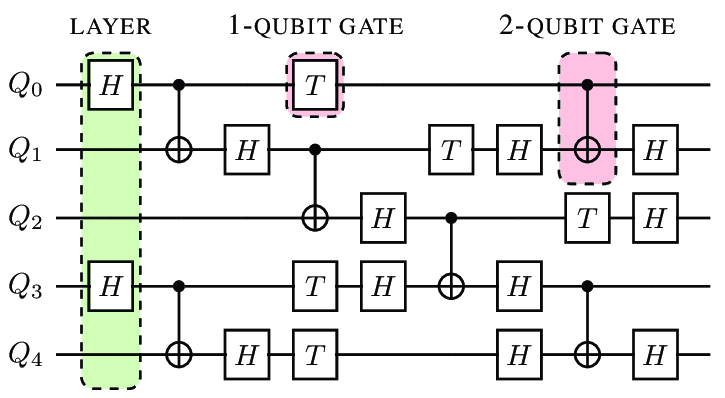
Quantum programming frameworks like Qiskit (IBM), Cirq (Google), and others allow developers to design experiments, visualize quantum circuits, execute algorithms on quantum computers and simulators, and utilize tools for analysis. However, these are still largely experimental, as quantum hardware capabilities are too limited for practical applications beyond a handful of use cases.
Another major area of software development lies in error correction and decoherence mitigation techniques to counteract instability and “noise” in quantum systems as they scale up. Techniques like surface codes and other topological approaches show promise in addressing these crucial issues.
From Theory to Real-World Applications
While firmly rooted in well-tested quantum mechanics, demonstrating quantum computing’s advantages over classical computers for practical applications has remained an elusive challenge. However, we are making steady progress in realizing this potential.
Quantum Advantage and Key Applications
As of 2022, researchers have been able to demonstrate a limited form of “quantum advantage” on existing hardware, where quantum computers can outperform classical systems on carefully constructed sampling problems or specialized optimization tasks.

However, these are still academic examples with no immediate practical use. For quantum computing to achieve true real-world relevance, we will likely need universal error-corrected logical qubit arrays with at least hundreds or thousands of qubits operating in unison.
Some key areas where large-scale quantum computers could eventually excel include:
• Cryptography/Cybersecurity – Their ability to factor large numbers and use Shor’s algorithm could crack modern RSA encryption, but also lead to new “quantum-proof” crypto methods.
• Optimization/Simulation – Finding optimal solutions to incredibly complex problems like more efficient logistics/supply chains, proteins folding, financial models, etc. Accurately simulating quantum behavior at the molecular level.
• Search Algorithms -Leveraging quantum parallelism for ultra-fast searches across truly massive datasets in fields like machine learning, drug discovery, etc.
• Artificial Intelligence/Machine Learning – Quantum computers could accelerate training advanced AI models with exponentially more data inputs and higher dimensionality.
• Chemistry/Materials Science – Accurately simulating molecular interactions and quantum behaviors to enable breakthroughs in areas like energy production, catalysts, superconductors, efficient batteries, and more.
It’s still early days, but we are already seeing major entities across big tech, finance, aerospace, pharmaceuticals and other sectors investing heavily into quantum research to gain a stake in this potentially revolutionary field.
The Quantum Computing Ecosystem Emerges
As formidable as the hardware and software challenges are, the immense potential of quantum computing is driving a rapidly expanding ecosystem spanning the public and private sectors, universities, and technology leaders. Billions of dollars are being invested worldwide into developing quantum hardware, algorithms, software, and critically – skilled quantum engineers and programmers.

Technology giants like Google, IBM, Microsoft, Amazon and Intel all have active quantum computing projects underway and have already brought commercial quantum computing cloud services online for customers to access and experiment with current hardware. Startups like IonQ, Rigetti, D-Wave, PsiQuantum and others are also pioneering new quantum architectures.
For these tech giants, being at the forefront of a commercially viable, large-scale quantum computing platform could catapult them into a new paradigm of computational capabilities far surpassing anything achievable with classical systems alone. Applications like cryptography, logistics optimization, and machine learning could experience a transformative boost in power and capability from the massively parallel processing power of quantum machines.
At the same time, national governments from the US to China, Europe and others are pouring massive funding into quantum computing research, viewing the technology as a critical strategic priority on par with artificial intelligence and other cutting-edge fields. In addition to quantum computing, applications of quantum sensing, quantum communications and other “quantum 2.0” fields are also seen as key areas for research and investment.
It’s still highly uncertain when or even if we will achieve large-scale, error-corrected quantum computers that can definitively demonstrate an overwhelming computational advantage for practical applications. Many experts estimate we may still be decades away from this quantum “supremacy.”
But even in the nearer-term, we are likely to see quantum computers combined with classical systems in hybrid architectures to enhance processing for AI, optimization, cryptography and simulations beyond the limits of classical-only systems. Businesses and entities who start building quantum skills and use cases today could be well-positioned for this future.
The Quantum Age Dawns
Like the classical computing revolution before it, the rise of quantum computing promises to usher in a new paradigm shift in our ability to process information and unlock new frontiers of human technological and scientific capabilities.
From simulating quantum physics to accelerating artificial intelligence and accelerating discoveries in materials science, energy production, pharmaceuticals and more – harnessing the power of quantum computing could fundamentally reshape entire industries and fields of research.
While formidable scientific and engineering challenges remain to scale and stabilize these fragile quantum computers, the field is progressing rapidly with both private and public sectors around the globe investing immense resources to be at the vanguard of this potentially revolutionary new technology.
And like the early days of classical computers over half a century ago, today’s quantum pioneers are already laying the foundations and infrastructure for a coming quantum age that may one day seem as unimaginable to us today as smartphones seemed to past generations. Unraveling the deepest mysteries of our universe while expanding human knowledge through unparalleled computational power is the tantalizing promise and potential of quantum computing.
Summary: Quantum computing represents the next paradigm shift in the capabilities of computational processing power. By harnessing the quantum mechanical effects of superposition and entanglement, quantum computers can vastly outpace classical computers on certain problems by performing exponentially more calculations in parallel using qubits instead of classical bits. Though still in its early stages, major private and public efforts are underway to develop scalable, error-corrected quantum hardware and software ecosystems. When fully realized, quantum computing promises extraordinary performance advantages in fields like cryptography, scientific simulations, AI/machine learning, materials science and more – opening up potential that may seem unimaginable today. With the power to expand the boundaries of human knowledge and technological capabilities, the quantum computing age is emerging as the next great frontier in computing.
If you like my work and want to have a conversation or work with me, please find me @ my LinkedIn profile.
Note: In order to illustrate my thought process easily, some images from internet were used.
 Srinivasrao Daruna